Digia Oyj 2025 SR
The report outlines Digia Plc's sustainability progress and performance for the fiscal year 2025, prepared in accordance with the EU Corporate Sustainability Reporting Directive (CSRD). The company achieved a 64% reduction in CO2 emissions from its 2019 baseline, driven by premises-related changes and the purchase of renewable energy. Digia also submitted its science-based emission reduction targets to the SBTi for assessment. In social responsibility, the company focused on employee wellbeing, diversity, and lifelong learning, achieving a 96% completion rate for annual Code of Conduct training. Additionally, Digia improved its customer Net Promoter Score (NPS) by 34% compared to 2022.
Company: Digia Oyj
Sector: Technology & telecommunications
Country: Finland
Year: 2025
Type: SR
Pages: 48
Back to company
Digia Oyj
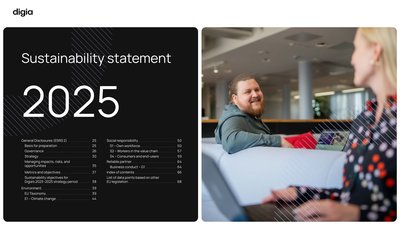
Sustainability Statement
The report outlines Digia Plc's sustainability progress and performance for the fiscal year 2025, prepared in accordance with the EU Corporate Sustainability Reporting Directive (CSRD). The company achieved a 64% reduction in CO2 emissions from its 2019 baseline, driven by premises-related changes and the purchase of renewable energy. Digia also submitted its science-based emission reduction targets to the SBTi for assessment. In social responsibility, the company focused on employee wellbeing, diversity, and lifelong learning, achieving a 96% completion rate for annual Code of Conduct training. Additionally, Digia improved its customer Net Promoter Score (NPS) by 34% compared to 2022.
Sign in for free to access detailed sustainability data, reporting standards, and ESG metrics.
Document Details
Report Year
2025
Reporting Period
Jan 1, 2025 - Dec 31, 2025
Fiscal Year
2025
Type
Sustainability Report
Language
English
Pages
File Size
Standards & Assurance
Reporting Standards
Materiality Assessment
Assurance
ESG Data?Experimental: AI-extracted data, may contain inaccuracies
Emissions
Scope 1:
Scope 2:
Scope 3:
Energy Consumption
Renewable Energy
Women on Board
Women in Management
Workplace Fatalities
Employees